
Coworking Spaces Market to Reach USD 43.16 Billion by 2032, Driven by Hybrid Work, Corporate Cost Optimization and Enterprise Demand, Says Mordor Intelligence
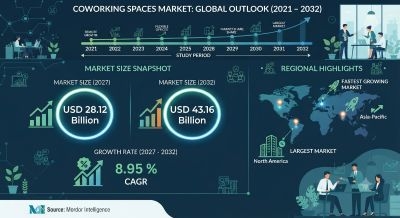
Hyderabad, India, November 27, 2026: According to Mordor Intelligence, the Coworking Spaces Market Size is expected to grow from USD 25.81 billion in 2026 to USD 28.12 billion in 2027 and reach USD 43.16 billion by 2032, registering a CAGR of 8.95% during 2027-2032. The market is gaining momentum as hybrid work expands demand for flexible office access, corporate real estate teams optimize occupancy costs, startups and entrepreneurs seek ready-to-use space, global capability centers expand, and demand moves into secondary cities and suburban locations.
The Coworking Spaces Industry is shifting toward a more enterprise-led model. Employers continue to require physical space for meetings, focused work, project teams, and periodic office attendance, but many are avoiding long property commitments. This favors operators with dense networks, private-office capacity, managed-office capabilities, reliable digital booking, and consistent service standards. Long lease commitments and the need to maintain service quality across locations remain important operating challenges.
Coworking Spaces Market Growth Drivers
Expansion of Hybrid Work and Flexible Office Models
Hybrid schedules are making flexible workspace a recurring part of workplace planning. Employees may need offices for meetings, collaboration, focused work, and periodic team sessions without requiring a permanent desk every day. Operators with broad local networks can support distributed workforces more effectively than single-location providers.
Corporate Real Estate Cost Optimization
Businesses are evaluating office portfolios against changing headcount and attendance patterns. Flexible arrangements can reduce upfront fit-out spending, limit underutilized capacity, and provide faster access to ready-to-use offices. Longer enterprise agreements can also provide operators with more stable revenue visibility.
Growth of Startups and Entrepreneurship
Startups, freelancers, and small project teams continue to create demand for ready-to-use offices with shorter commitments. Coworking locations can provide meeting rooms, desks, connectivity, and professional environments without requiring large upfront investment in conventional office premises.
Expansion of Global Capability Centers and Multinational Operations
Global capability centers and multinational companies are creating demand for secure, managed spaces with customized layouts and technology infrastructure. These users can require longer commitments and multi-location coverage, increasing the importance of enterprise-grade operating capabilities.
Increasing Adoption in Secondary Cities and Suburban Areas
Demand is expanding beyond traditional central business districts as employers seek workspace closer to distributed employees and new business hubs. Secondary cities and suburban markets can offer lower occupancy costs and create opportunities for operators that can maintain consistent service quality.
Access This Report in Japanese: https://www.mordorintelligence.com/ja/industry-reports/coworking-spaces-market?utm_source=abnewswire
Coworking Spaces Market Segmentation
By Size and Scale of Facility
-
Small
-
Medium
-
Large
By Sector
-
IT and ITES
-
BFSI
-
Business Consulting and Professional Services
-
Other Services (Retail, Life Sciences, Energy, Legal)
By End User
-
Freelancers
-
Enterprises
-
Start-ups and Others
By Geography
-
North America
-
United States
-
Canada
-
Mexico
-
South America
-
Brazil
-
Argentina
-
Rest of South America
-
Europe
-
Germany
-
United Kingdom
-
France
-
Italy
-
Spain
-
Russia
-
Rest of Europe
-
Asia-Pacific
-
China
-
India
-
Japan
-
South Korea
-
Australia
-
Rest of Asia-Pacific
-
Middle East
-
United Arab Emirates
-
Saudi Arabia
-
Rest of Middle East
-
Africa
-
South Africa
-
Nigeria
-
Egypt
-
Rest of Africa
By Size and Scale of Facility:
Medium-sized centers form the largest facility category, serving a broad mix of individual and corporate users. Large facilities are expected to expand faster as enterprise customers increasingly seek private offices, managed suites, meeting capacity, and multi-location access.
By Sector
IT and ITES remain the largest sector because technology companies value scalable, connected office environments and access to talent pools. BFSI, professional services, healthcare, legal, retail, life sciences, and energy users are also creating opportunities where security, privacy, and controlled access are important.
By End User
Enterprises lead the market as corporate customers increasingly use flexible workspaces to manage hybrid schedules and distributed teams. Startups, freelancers, and other individual users remain important for daily occupancy and market expansion, particularly in emerging business districts.
Market Regional Insights
North America remains a leading regional market, supported by mature enterprise adoption and established coworking operators. The United States has a well-developed coworking ecosystem with extensive inventory and a broad network of locations. Asia-Pacific is the fastest-growing region, with India emerging as an increasingly important flexible-office market. Europe is consolidating across mature coworking hubs, supported by established demand for flexible workspace solutions, while Brazil remains an important market in South America. In the Middle East, particularly the United Arab Emirates and Saudi Arabia, enterprise and startup demand is increasing. African growth prospects are supported by urbanization and the expansion of technology-related employment.
Explore Our Full Library of Real Estate and Construction Research Reports: https://www.mordorintelligence.com/market-analysis/real-estate-and-construction?utm_source=abnewswire
Coworking Spaces Market Key Players
The Coworking Spaces Market includes IWG plc, WeWork Companies LLC, The Office Group Ltd, Mindspace Business Parks REIT, Industrious, Impact Hub GmbH, Talent Garden S.r.l., Huckletree, betahaus, WorkRepublic GmbH, Fora Space, Second Home, Tribes, Servcorp Ltd, Techspace Group Ltd, Morning, Cubo Work, Orega, Runway East, Wizu Workspace, Desana, Hubble, and The Executive Centre.
The market is moderately concentrated, with global platforms competing alongside regional and local operators. Major players are using management agreements, franchise partnerships, technology platforms, and network expansion to grow with lower direct lease exposure. Competitive differentiation is increasingly based on enterprise relationships, network density, private-space availability, digital booking, security, and service consistency.
Coworking Spaces Market Forecast
The Coworking Spaces Market Forecast remains positive as employers continue to balance office attendance with flexible workplace strategies. Enterprise-led demand is expected to remain important as companies seek multi-location access, private offices, meeting capacity, and flexible commitments.
Operators are expected to expand through partnerships and management agreements while targeting secondary cities and suburban markets. These models can support network growth without requiring operators to lease every location directly. Digital booking, standardized service delivery, and enterprise account management will remain important capabilities.
At the same time, long property commitments can pressure profitability when occupancy and membership revenue fluctuate. Operators will need disciplined location selection, efficient operations, differentiated services, and strong customer retention to maintain sustainable growth.
For more insights on this market, please visit the Mordor Intelligence page: https://www.mordorintelligence.com/industry-reports/coworking-spaces-market?utm_source=abnewswire
About Mordor Intelligence
Mordor Intelligence is a global market intelligence firm, founded in 2014, helping businesses make informed decisions through data-driven insights, industry expertise, and advanced analytics. With 550+ domain experts and on-ground specialists across 180+ countries, the company delivers comprehensive intelligence across aerospace & defense, agriculture, automation, automotive, chemicals & materials, consumer goods & services, electronics, energy & power, financial services, food & beverages, healthcare, hospitality & tourism, information & communications technology, and logistics. Its offerings include syndicated industry reports, custom research and advisory, and subscription platforms such as Synapse, Data Center Intelligence, and Robotics Intelligence. Mordor Intelligence is ISO 9001:2015 and ISO/IEC 27001:2022 certified, a member of ESOMAR and the Market Research Society of India, and a four-time Great Place to Work® honoree. Learn more at mordorintelligence.com.
For any inquiries or to access the full report: [email protected], https://www.mordorintelligence.com/contact-us
Media Contact
Company Name: Mordor Intelligence
Contact Person: Jignesh Thakkar
Email: Send Email
Phone: +1 617-765-2493
Address:11th Floor, Rajapushpa Summit, Nanakramguda Rd, Financial District, Gachibowli [email protected]
City: Hyderabad
State: Telangana 500008
Country: India
Website: https://www.mordorintelligence.com/


