
Natural Vitamin E Market Size Set to Reach $1.50 Billion by 2031 Driven by Dietary Supplements & Functional Food Fortification – Mordor Intelligence
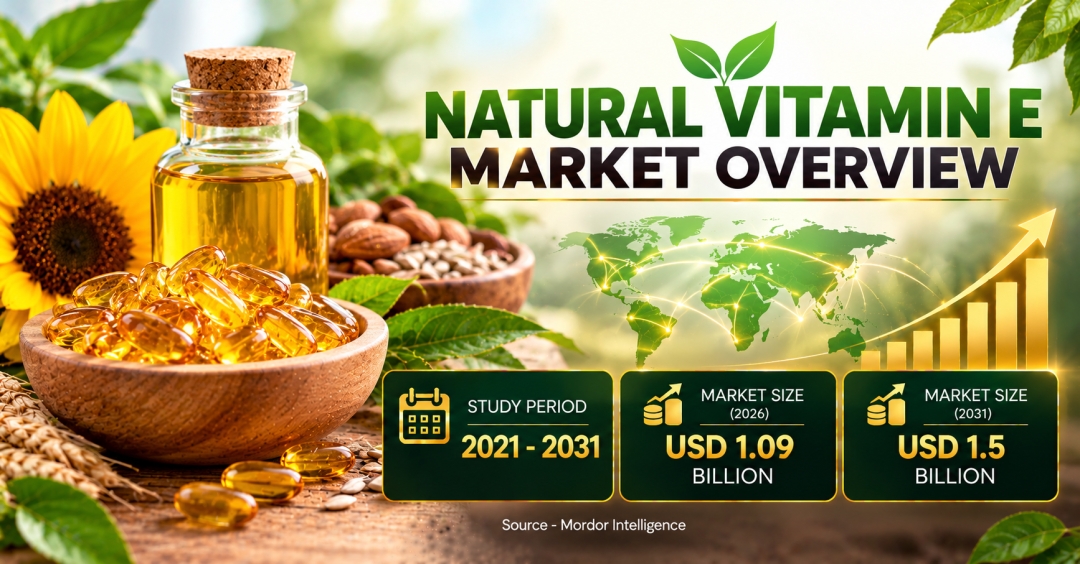
Hyderabad, November 03, 2026: According to Mordor Intelligence, the natural vitamin E market size is estimated to grow from $1.09 billion in 2026 to reach $1.50 billion by 2031, registering a CAGR of 6.62% during the forecast period (2026-2031). The market expands as commercial food processors, dietary supplement brands, and cosmetic formulators replace synthetic petroleum-derived vitamins with bioavailable, plant-extracted isomers. Increasing consumer awareness of lifestyle diseases, strong consumer interest in preventive healthcare, and documented antioxidant health validations support steady demand across retail, healthcare, and digital sales channels worldwide.
The natural vitamin E market growth is also shaped by international regulatory authorizations and changing buyer expectations regarding supply continuity and feedstock verification. Ingredient manufacturers are focusing on multi-oil extraction lines, allergen-free non-GMO certifications, and yield optimization. These operational measures help processors navigate feedstock price swings and supply disruptions while maintaining antioxidant activity, lipid stability, and clean-label compliance. Together, these factors strengthen the natural vitamin E market forecast across established and emerging functional ingredient markets.
Natural Vitamin E Market Trends
Clean-Label Dietary Supplements and Regulatory Approvals Accelerate Commercial Adoption
One of the leading natural vitamin E market trends is the sustained demand for natural d-alpha-tocopherol in preventive healthcare and wellness products. Consumers and healthcare professionals increasingly favor natural forms over synthetic dl-alpha variants due to their superior biological retention and cellular uptake. Official recognitions, such as the European Food Safety Authority’s authorized antioxidant health claims and the United States Food and Drug Administration’s GRAS status for vegetable-oil-derived tocopherols, provide formula safety validation. These regulatory frameworks encourage supplement brand owners to reformulate daily multivitamins and softgels with natural extracts, supporting the natural vitamin E industry.
Beauty and Personal Care Formulations Outpace Conventional Applications
While dietary supplements provide a steady consumption baseline within the natural vitamin E market share, beauty and personal care products represent the fastest-growing application category. Cosmetic formulators incorporate tocotrienols and mixed tocopherols into anti-aging serums, facial creams, and sun-care treatments to prevent lipid peroxidation and neutralize ultraviolet-induced oxidative stress. Natural tocopherols also serve as natural shelf-life stabilizers in plant-oil-based cosmetics, aligning with broader formulation standards seen across the integrated food ingredients industry for natural preservative systems.
Multi-Feedstock Sourcing Mitigates Raw Material Price Volatility
Feedstock diversification remains an essential development area across the natural vitamin E market growth. Historically, soybean oil deodorizer distillate served as the primary raw material for commercial extraction. However, rising demand for non-GMO and allergen-free alternatives has led processors to expand extraction from sunflower, rapeseed/canola, and palm oils. Sunflower-derived tocopherols provide a reliable supply chain that bypasses major food allergen declarations, helping ingredient refiners fulfill strict clean-label specifications for infant nutrition and functional beverages.
Tocopherols Retain Volume Scale While Tocotrienols Gain Clinical Focus
Product type selection continues to guide market development patterns. Mixed tocopherols account for the majority of total sales volume due to their broad adoption as natural antioxidants in food preservation and daily nutritional supplements. Concurrently, tocotrienols are gaining ground in specialized therapeutic formulations. Clinical studies highlighting the cardioprotective and neuroprotective properties of tocotrienol isomers encourage nutraceutical manufacturers to launch premium specialty formulations targeting cardiovascular and metabolic wellness.
Asia-Pacific Anchors Supply and Consumption While North America Drives Value
Regional consumption patterns continue to guide the natural vitamin E market forecast. The Asia-Pacific region holds the largest regional market share, supported by extensive oilseed processing infrastructure in China and palm tocotrienol refining in Malaysia, alongside rising middle-class spending on fortified foods. Concurrently, North America represents a high-value consumer market, propelled by established dietary supplement habits, high consumer disposable incomes, and widespread retail distribution through pharmacies, supermarkets, and specialized online channels.
Check out more details and stay updated with the latest industry trends, including the Japanese version for localized insights: https://www.mordorintelligence.com/ja/industry-reports/natural-vitamin-e-market?utm_source=abnewswire
Natural Vitamin E Market Segmentation
By Product Type
- Tocopherols (Alpha, Beta, Gamma, and Delta)
- Tocotrienols
By Source
- Soybean Oil
- Rapeseed/Canola Oil
- Sunflower Oil
- Others (Palm Oil, Wheat Germ Oil)
By Application
- Dietary Supplements
- Fortified/Functional Food and Beverage
- Beauty and Personal Care Products
- Others (Animal Nutrition, Pharmaceuticals)
By Geography
- North America
- Europe
- Asia-Pacific
- South America
- Middle East and Africa
Competitive Landscape of the Natural Vitamin E Industry
The natural vitamin E industry exhibits a moderately consolidated competitive structure, with multinational chemical corporations, global agribusiness leaders, and specialized natural ingredient refiners competing across extraction efficiency, isomer purity, and supply reliability. Market participants strengthen their market presence by expanding multi-feedstock processing facilities, securing long-term vegetable oil distillate supply contracts, and broadening certified organic and non-GMO portfolios.
Extraction yield optimization, molecular distillation precision, and color-stabilization technologies serve as primary areas of technical differentiation. Suppliers invest in advanced purification columns to remove residual pesticide traces and produce high-potency clear oils that integrate smoothly into clear beverages and cosmetic emulsions. Ingredient manufacturers also collaborate directly with food and supplement brands to develop customized antioxidant blends. These initiatives help suppliers protect their natural vitamin E market share while maintaining quality consistency across global supply chains.
Geographic diversification and strategic inventory management remain standard business practices. Leading producers operate multi-regional extraction facilities across North America, Europe, and Asia to minimize operational exposure to localized facility disruptions. As commercial demand for natural antioxidants and functional nutrients continues to rise, the natural vitamin E market forecast remains supported by ongoing investments in green extraction chemistry, sustainable agriculture partnerships, and international distribution agreements.
Key Players
Major companies operating in the natural vitamin E market include:
- BASF SE
- Archer Daniels Midland Company
- Brenntag AG
- Merck KGaA
- dsm-firmenich
Conclusion
The natural vitamin E market forecast points toward steady expansion as commercial food manufacturers, supplement producers, and cosmetic brands continue transitioning from synthetic additives to plant-derived bioactives. Ingredient refiners respond by broadening sunflower and rapeseed extraction capabilities, refining tocotrienol separation techniques, and developing water-dispersible formulations that integrate easily into functional beverages and dry blends. These technical developments support sustained ingredient utilization across human nutrition and personal care sectors.
Regional conditions offer clear commercial pathways. Asia-Pacific provides an established agricultural processing baseline supported by expanding consumer demand for fortified foods, while North America presents reliable high-value demand through established dietary supplement channels. These complementary market conditions create clear expansion routes for natural ingredient manufacturers worldwide.
Overall, the natural vitamin E market size will continue to benefit from shifting consumer health preferences, growing demand for verified plant-based nutrition, wider availability across digital and brick-and-mortar retail channels, and ongoing improvements in extraction science. These combined market factors support sustained natural vitamin E market growth while reinforcing the commercial position of the global natural vitamin E industry.
Industry Trending Reports
Vitamin A Market: The global vitamin A market is projected to register a 4.30% CAGR through the forecast period, driven by escalating clinical micronutrient deficiencies, mandatory food fortification mandates, and rising consumer demand for functional, vision-supporting foods. Significant volumetric uptake continues across commercial livestock feed to maximize meat and dairy yields, while clean-label personal care brands expand naturally derived, anti-aging retinoid formulations. Ingredient suppliers are advancing microencapsulated and bio-stabilized grades to safeguard active potency against oxidative degradation in processed functional foods and therapeutic supplements.
Vitamin E Market Size: The global vitamin E market is estimated at $3.22 billion in 2026 and is forecast to climb to $4.26 billion by 2031, achieving a 5.78% CAGR. Category growth is propelled by consumer awareness of cellular antioxidant protection and the cosmetic industry’s integration of tocopherols and tocotrienols for dermatological hydration and anti-aging efficacy. To satisfy clean-label and allergen-free dietary preferences, ingredient processors are shifting extraction from synthetic chemicals toward non-GMO, plant-based feedstocks derived from sunflower, safflower, and soybean oil deodorizer distillates.
Vitamin and Mineral Premixes Market Share: The global vitamin and mineral premixes market is valued at $8.04 billion in 2025 and is anticipated to reach $11.02 billion by 2030, advancing at a 6.51% CAGR. Growth is sustained by expanding government nutrition fortification mandates across more than 80 countries, along with industrial feed formulations supporting modern livestock agriculture throughout Asia-Pacific. Following raw-material manufacturing disruptions across major European chemical facilities, premix formulators are strengthening regional blending hubs and developing multi-nutrient microencapsulated complexes to ensure consistent bioavailability and supply security.
About Mordor Intelligence:
Mordor Intelligence is a global market intelligence firm, founded in 2014, helping businesses make informed decisions through data-driven insights, industry expertise, and advanced analytics. With 550+ domain experts and on-ground specialists across 150+ countries, the company delivers comprehensive intelligence across aerospace & defense, agriculture, automation, automotive, chemicals & materials, consumer goods & services, electronics, energy & power, financial services, food & beverages, healthcare, hospitality & tourism, information & communications technology, and logistics.
Its offerings include syndicated industry reports, custom research and advisory, and subscription platforms such as Synapse, Data Center Intelligence, and Robotics Intelligence. Mordor Intelligence is ISO 9001:2015 and ISO/IEC 27001:2022 certified, a member of ESOMAR and the Market Research Society of India, and a four-time Great Place to Work® honoree.;
Media Contact
Company Name: Mordor Intelligence
Contact Person: Jignesh Thakkar
Email: Send Email
Phone: +1 617-765-2493
Address:11th Floor, Rajapushpa Summit, Nanakramguda Rd, Financial District, Gachibowli [email protected]
City: Hyderabad
State: Telangana 500008
Country: India
Website: https://www.mordorintelligence.com/industry-reports/natural-vitamin-e-market?utm_source=abnewswire


